Atmospheric Blocking & Large-Scale Circulation Dynamics
I investigate blocking, jet stream behaviour, Rossby wave patterns and persistent circulation regimes, including how diagnostic choices affect their inferred climatology and future change.
Climate Scientist · Atmospheric Dynamics & Climate Extremes
Atmospheric Blocking · Internal Variability · Large Ensembles · Ocean–Atmosphere Interactions · Earth System Modelling
I study how atmospheric circulation shapes high-impact weather extremes, why climate-model outcomes diverge, and which dynamical signals remain robust despite internal variability and methodological uncertainty.
Currently seeking postdoctoral and research scientist opportunities in atmospheric dynamics, climate extremes, predictability, and Earth system modelling. Interested in interdisciplinary climate research as well. Keen to connect!
Just a curious climate scientist!
I completed my PhD (Geophysics) at Victoria University of Wellington, New Zealand, working with an amazing supervisor Prof. James Renwick. My thesis, Tipping the scales: The butterfly effect in Atmospheric Blocking and Temperature Extremes, examined how blocking, internal variability, and circulation uncertainty shape extreme-temperature risk under warming climate.
My research combines developing new methods, weather/climate model simulations, large climate-model ensemble assessment, circulation diagnostics, statistical analysis, and high-performance computing. A central theme is separating robust dynamical signals from outcomes that depend strongly on detection choices or internal variability (The so called 'butterfly effect').
My broader background and diverse research portfolio spans ocean–atmosphere interaction, climate teleconnections, Indian monsoon predictability, air–sea exchange modelling (physical and chemical), numerical/earth system modelling and climate model evaluation. I am especially interested in connecting atmospheric/ocean dynamics to predictability and decision relevant climate risk.
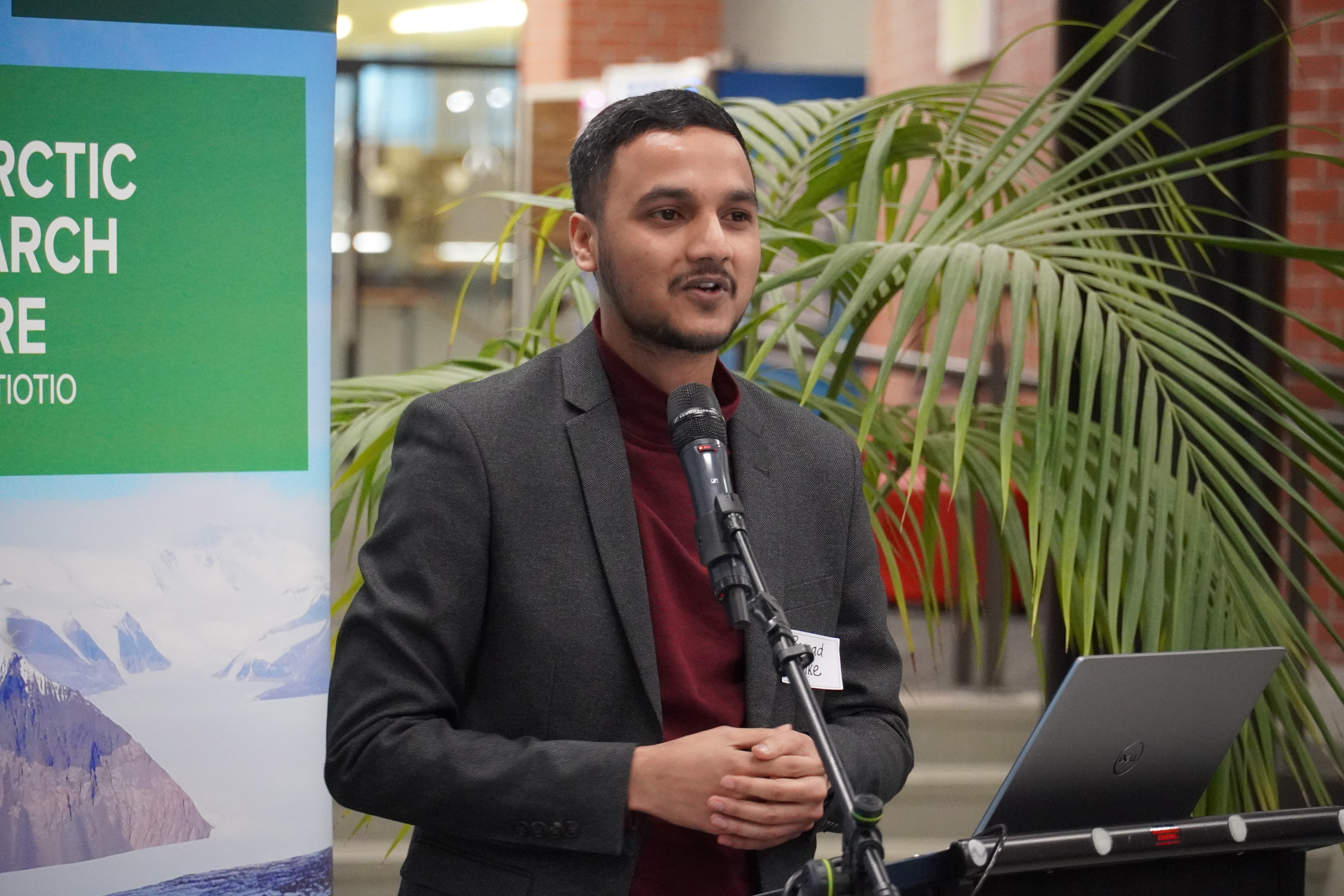
Delivering a public talk on
Atmospheric Blocking
Wellington, New Zealand
The scientific questions connecting my past work, current projects, and potential future research interests.
I investigate blocking, jet stream behaviour, Rossby wave patterns and persistent circulation regimes, including how diagnostic choices affect their inferred climatology and future change.
I use climate models and large ensembles to quantify risks due to temperature extremes, compound blocked extremes, role of internal variability, and the spread of plausible climate outcomes under common forcing.
I study atmospheric sensitivity, confidence in projected change, divergent ensemble trajectories, and dynamical precursors that can help explain why rare high-impact events emerge.
My earlier work examined Pacific Ocean temperature signals, Indian summer monsoon predictability, and oceanic teleconnections associated with drought and regional climate variability across Northern Hemisphere.
Across global, regional and process-oriented modelling, I am interested in physically interpretable diagnostics that connect model behaviour to circulation, air–sea exchange and environmental impacts (including recent developments in AI/ML techniques).
Project titles link to dedicated pages (emerging) into individual research portfolios (stay tuned).
Question. How strongly does the diagnosed blocking climatology depend on whether blocking is defined by flow reversal or by persistent geopotential height anomaly?
Contribution. Demonstrated that Southern Hemispheric blocking detection method sensitivity is itself a major observational and methodological constraint, while identifying aspects of projected future change.
Question. Can a blocking diagnostic be designed around the distinctive stronger zonal flow, oceanic midlatitudes and circumpolar storm-track dynamics of the Southern Hemisphere?
Contribution. Developed a novel hemisphere-aware framework that combines anomaly, gradient, and persistence constraints for robust blocking detection.
Status: Manuscript close to submission.
Question. How does CESM-LENS2 represent Northern Hemisphere blocking, and what circulation structures help explain regional model bias and projected change?
Approach. Used hybrid blocking detection across the large ensemble, combined with circulation and jet-stream diagnostics for bias attribution.
Status: Manuscript in preparation.
Question. Does blocked-heat extreme risk remain or increase even where blocking frequency decline in future?
Contribution. Separating circulation/frequency effects from conditional risk effects to show how dynamics and a warmer thermodynamic background jointly shape future heat and cold extremes.
Status: Manuscript close to submission.
Question. Where are projected changes distinguishable from the large spread generated by internal variability?
Contribution. Developed a unique ensemble-based confidence information for blocking, heat waves, cold waves and co-located blocked extremes, including spatial significance and false-discovery-rate control.
Strong Value: A reusable Global uncertainty framework for circulation and compound-extreme analysis.
Question. How can ocean thermal variability and remote oceanic teleconnections inform Indian summer monsoon and drought variability?
Background. My master's thesis examined Indian summer monsoon predictability using Pacific Ocean mean temperature, followed by climate risk assessment, mitigation and adaptation related research at IIT Bombay on oceanic teleconnections and Indian drought.
Theme: Ocean–atmosphere coupling, monsoon variability and climate predictability.
Focus. Atmospheric and environmental modelling within an international research network, including regional modelling and pollution/dispersion processes over the Mediterranean.
Broader value. This work expanded my experience into regional atmosphere–ocean process modelling (including model development) and environmental applications.
Research direction. Use targeted branching ensembles around high-impact events to identify when small circulation differences amplify into divergent outcomes.
Proposed framework. Branch before an event, diagnose divergence in blocking, jets and Rossby-wave structure, then re-branch around candidate dynamical leverage points.
Goal: Connect dynamical meteorology, large ensembles and interpretable data-driven diagnostics for rare-event predictability. I am working on turning more amazing ideas into research proposals across diverse research themes. Get in touch to know more.
Dissemination of research findings.
Shelke, P. B. & Renwick, J. A. (2026). Southern Hemispheric atmospheric blocking patterns in CESM-LENS2: Effects of Reversal versus Anomaly approaches. Geophysical Research Letters, 53, e2025GL120428.
Supporting students, assessments, scientific discussions and peer reviews.
PHYG413 Climate Dynamics, Victoria University of Wellington (2026). Teaching support and assessment for coursework, including evaluation and feedback for research reports.
Co-supervision. Supporting a Master's thesis on Antarctic sea-ice variability and historical/modern stressors on sea-ice extent.
EGU 2026 session co-convener. Atmospheric Rossby waves, Blocking and Jet Stream Dynamics, and their Impacts on Extreme Weather and Climate Events.
Reviewer for Journal of Geophysical Research: Atmospheres and Geophysical Research Letters.
Selected invited and conference presentations.
June 2025 · Colorado, USA
“‘LENS’ing through Internal Variability in the Heat waves”
Oral PresentationApril 2025 · Vienna, Austria
“Does ‘Blocking’ Shape the Future of Antarctic Heat Extremes?”
Oral PresentationNovember 2024 · Auckland, New Zealand
“Is the Community Earth System Model up to the challenge of Southern Hemispheric blocking?”
Oral PresentationOctober 2024 · Virtual
“Present and Future Implications of Atmospheric Blocking in a Warming World”
Invited TalkAugust 2024 · Colorado, USA
“Are we missing future extreme events by ignoring less persistent blocking?”
Invited TalkJune 2024 · Wellington, New Zealand
“Global Atmospheric Blocking: Present and Future Implications”
Invited TalkApril 2024 · Vienna, Austria
“Are we missing future extreme events by ignoring less persistent blocking?”
Oral PresentationMarch 2024 · Colorado, USA
“Atmospheric Blocking in Community Earth System Model Large Ensemble 2”
Poster PresentationDecember 2023 · San Francisco, USA
Poster PresentationNovember 2023 · Wellington, New Zealand
“Atmospheric Blocking Representation in the Community Earth System Model Large Ensemble 2”
Oral PresentationJanuary 2022 · Grenoble, France — Virtual
“Regional 3D Atmosphere and Ocean Models to quantify the Impact of Oceanic Sources on the Regional Mercury Budget”
Poster PresentationJanuary 2019 · Pune, India
“Impact of Satellite Altimeter Derived Ocean Mean Temperature of Nino 3.4 Region on Indian Summer Monsoon Rainfall”
Poster PresentationSelected honours & awards in recent years.
Capabilities I can bring directly into a postdoctoral or collaborative research project.
CESM-LENS2 · CESMv2/3 · WRF-ARW · WRF-Chem · Polar-WRF · DCMIP dynamical cores
Atmospheric blocking · jet streams · Rossby-wave patterns · circulation composites · extreme-event diagnostics · lagged risk · frequency/risk decomposition
Python · xarray · Dask · NumPy · pandas · SciPy · matplotlib · Cartopy · FORTRAN · MATLAB · NCL · CDO/NCO
Parallel Workflows · NeSI · NCAR Derecho · Aditya HPC · Slurm · Shell scripting · large multi-member ensemble workflows · reproducible pipelines
Ensemble uncertainty · signal-to-noise · inter-member agreement · unique confidence maps · false-discovery-rate control · detection and attribution
ANN · CNN · GLMs · Data clustering · interest in explainable/interpretable ML and AI weather-model diagnostics for climate extremes